Vulture
The Problem It Solves
The "Information Half-Life" Crisis
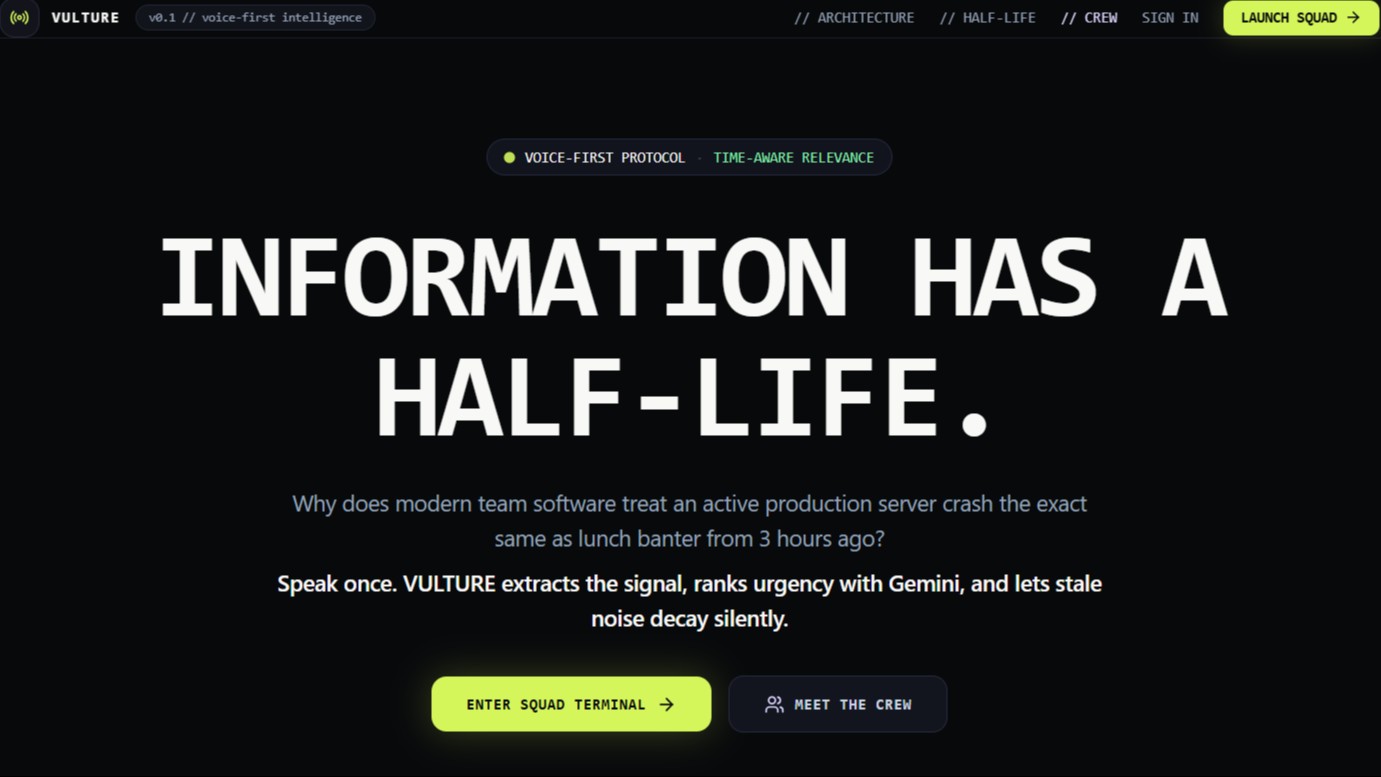
In modern team collaboration tools (Slack, Teams, Discord, WhatsApp), every message is treated with identical permanence and flat visual priority. An active database crash, a server failover alert, and a joke about lunch from three hours ago all occupy the same vertical channel space. As a result, critical operational feeds rapidly decay into cognitive noise, forcing on-call responders to manually sift through stale chatter to determine what is happening right now.
Furthermore, during active high-stakes incidents—production downtime, security threats, or emergency field operations—typing out detailed reports on a phone or laptop keyboard introduces dangerous friction and pulls focus away from mitigating the issue.
What People Use VULTURE For
VULTURE is a voice-first tactical squad broadcasting system engineered for operational speed:
- Incident Response & SRE Squads: Speak for five seconds during an active infrastructure outage ("Database pool saturated in us-east-1, failing over to replica"). Responders stay hands-on while the squad receives an instant, prioritized briefing.
- Security & Ops Teams: Fast verbal dissemination of threat vectors or access lockouts without typing essays or context-switching between monitoring consoles.
- Tactical Field & Engineering Syncs: Ephemeral voice broadcasts and alerts that automatically self-decay after their window of relevance, eliminating channel clutter.
How It Makes Tasks Faster, Easier, and Safer
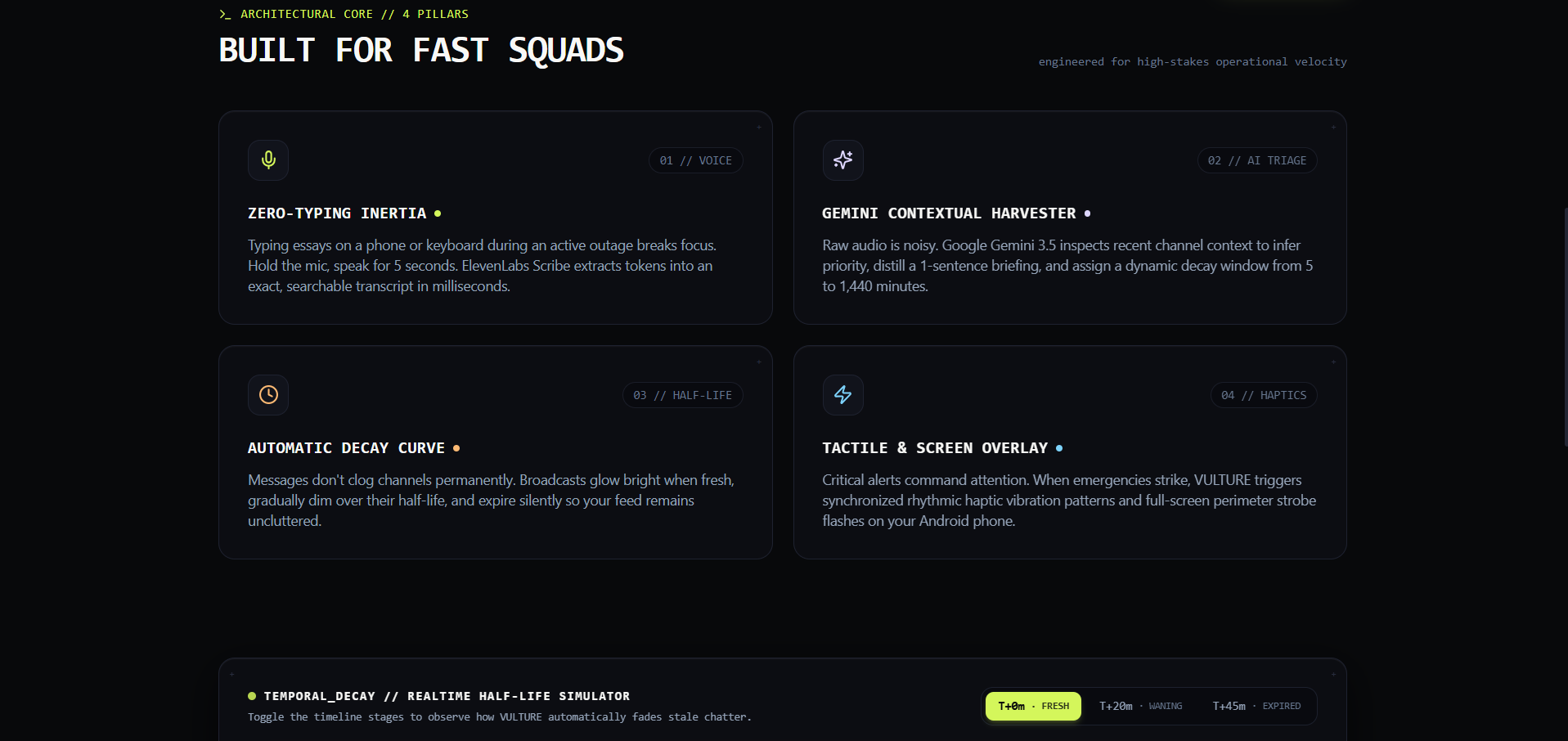
- Zero-Typing Velocity: Speaking is 4× faster than typing. By holding the mic for five seconds, ElevenLabs Scribe converts voice audio into an exact transcript with zero latency and zero friction.
- Autonomous Cognitive Triage: Google Gemini 3.5 inspects channel history and spoken context to extract a 1-sentence executive summary, calculate an urgency score (0–100), and classify severity (
CRITICAL,HIGH,NORMAL,LOW) automatically. - Automatic Half-Life Decay: Messages don't linger forever. Each broadcast glows vibrant when fresh, gradually dims over its assigned half-life (5m to 24h), and silently expires once resolved, keeping feeds actionable.
- Attention-Grabbing Tactile Alerts: Critical incidents bypass notification blindness by triggering synchronized rhythmic haptic vibrations and perimeter screen flashes on responders' devices, ensuring emergencies cut through noise immediately.
Challenges we ran into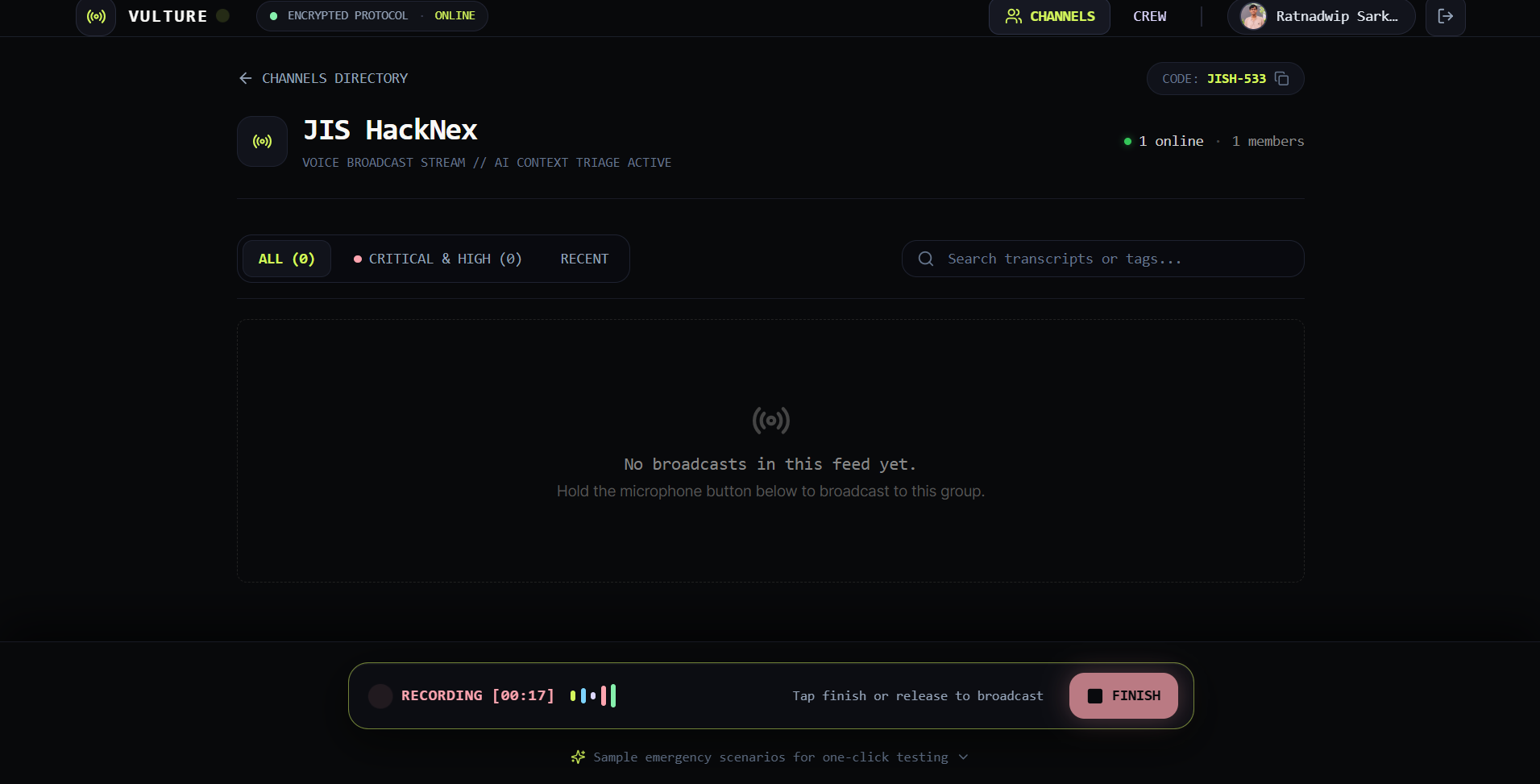
Challenges We Ran Into
1. Browser WebM Audio Streaming & Codec Fragmentation
- The Hurdle: The browser
MediaRecorderAPI outputs variable Opus/WebM container headers depending on the client platform (Android Chrome vs. Desktop Safari). When streaming voice audio to the server, malformed container chunk boundaries occasionally caused ElevenLabs Scribe to reject audio buffers. - How We Solved It: Standardized binary audio capture by probing supported MIME types (
audio/webm;codecs=opuswith fallback toaudio/webm), capturing audio in discrete 100ms time-slices, and properly finalizing the container headers into a cleanBlobbefore dispatching to our server-side transcription handler.
2. Eliminating LLM Hallucinations & Schema Drift in Real-Time Triage
- The Hurdle: Real-time broadcast triage requires deterministic urgency scores, discrete priority enums, and tight half-life windows. Early LLM prompts occasionally returned markdown commentary or conversational preambles that broke downstream JSON parsing.
- How We Solved It: Integrated Google Gemini 3.5 with strict Zod schema validation and calibrated operational few-shot prompts. We enforced strict JSON response mode, ensuring 100% deterministic output (
priority,urgencyScore,expiresInMinutes,summary) with sub-second response times.
3. Cross-Device Tactile Alert Parity
- The Hurdle: Modern mobile browsers restrict the Web Vibration API (
navigator.vibrate) unless explicitly triggered within active user gesture contexts, making incoming background alerts tricky to deliver haptically. - How We Solved It: Architected an internal custom event bus (
vulture:flash) tied to incoming polling streams. When a responder has the squad channel open, incoming high-priority messages immediately trigger priority-weighted rhythmic vibration pulses (e.g., rapid SOS patterns forCRITICALincidents) paired with high-visibility screen strobe overlays.