Valmont financial group
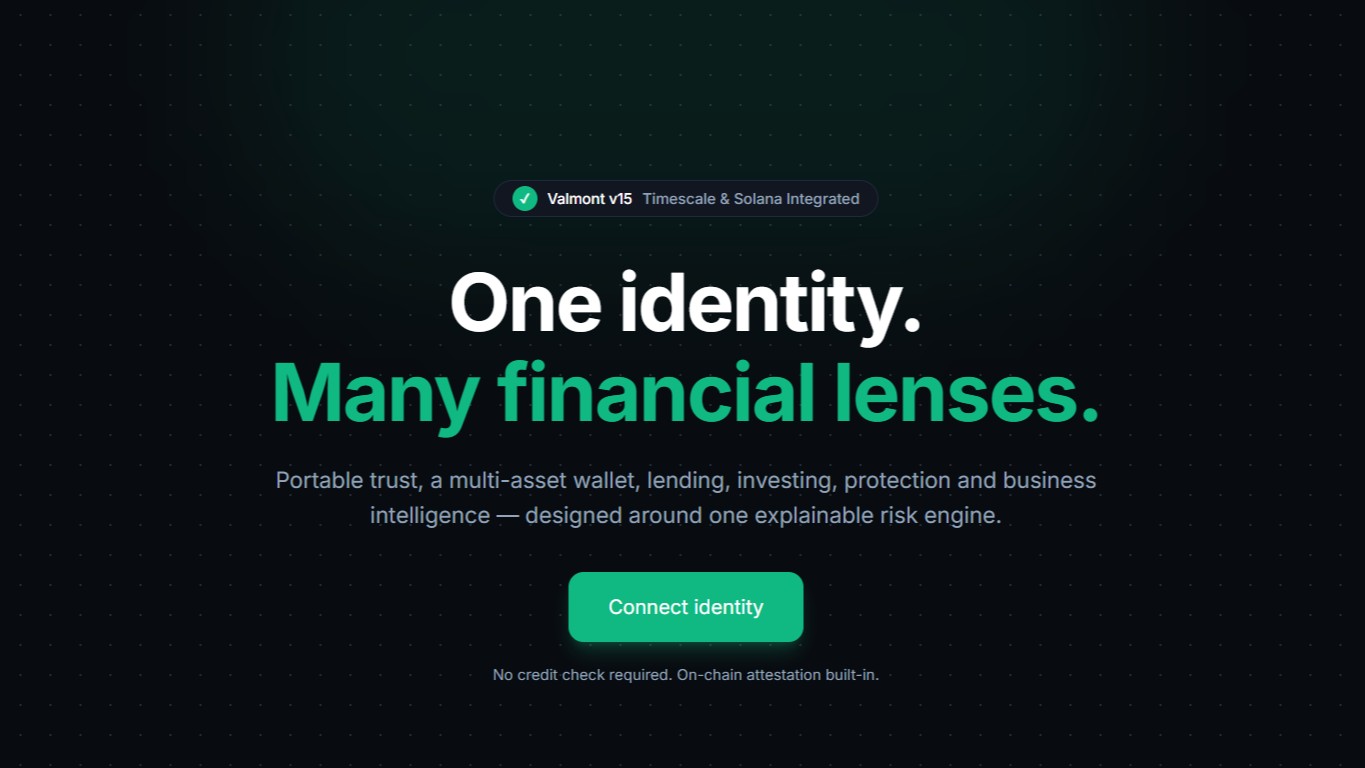
1. Vision & Problem Statement
The problem: Financial services are fragmented. A person needs a separate app or institution for a wallet, for credit history, for a loan, for investing, and for a place to park savings — and every time they move between them, they rebuild trust from zero. Meanwhile banks and merchants each sit on siloed risk data, unable to see a person's real financial behavior outside their own walls. This locks out anyone without a formal financial paper trail — the exact population most in need of access.
The vision: One platform. One portable, on-chain identity and trust score that travels with the person. On top of it: a wallet spanning fiat and crypto, borrowing, AI-guided investing across stocks, crypto, mutual funds, fixed income, gold, and retirement, insurance, remittances, and financial education for all of it — plus the same underlying risk signal, repackaged as a loan-loss/default-risk product for banks, a premium-pricing signal for insurers, and a treasury/payroll/supply-chain-finance layer for enterprises, serving individuals, students, merchants, migrant workers, and corporations under one identity.
In one sentence: The only finance app a person needs — and the risk infrastructure banks need to trust them.
2. User Personas & Journeys
Persona A — Individual (gig worker, salaried employee, student, small merchant — anyone)
Persona B — Lender (bank, merchant, or individual lender funding loans on the platform)
Persona C — Auditor/Regulator (stretch, transparency-only view — optional, not core)
Persona D — Enterprise/Corporation (treasury client, payroll/gig-disbursement client, embedded-finance client)
Persona E — Migrant Worker / Remittance Sender (a specific, high-value path through Persona A, given its own journey below because it maps directly to the FinTech track's own "cross-border remittances" wording)
Journey A: Individual — full lifecycle
- Onboard — sign up via Auth0, guided by an ElevenLabs voice agent; select a learning-plan persona/time budget (e.g. small merchant ~1 hr/day, student ~4-5 hrs, or custom)
- Build trust score — upload income proof/ledger photos (Gemini OCR extracts income signal); ongoing transaction activity is watched in real time (Tiger Data) for a fraud-clean behavioral signal
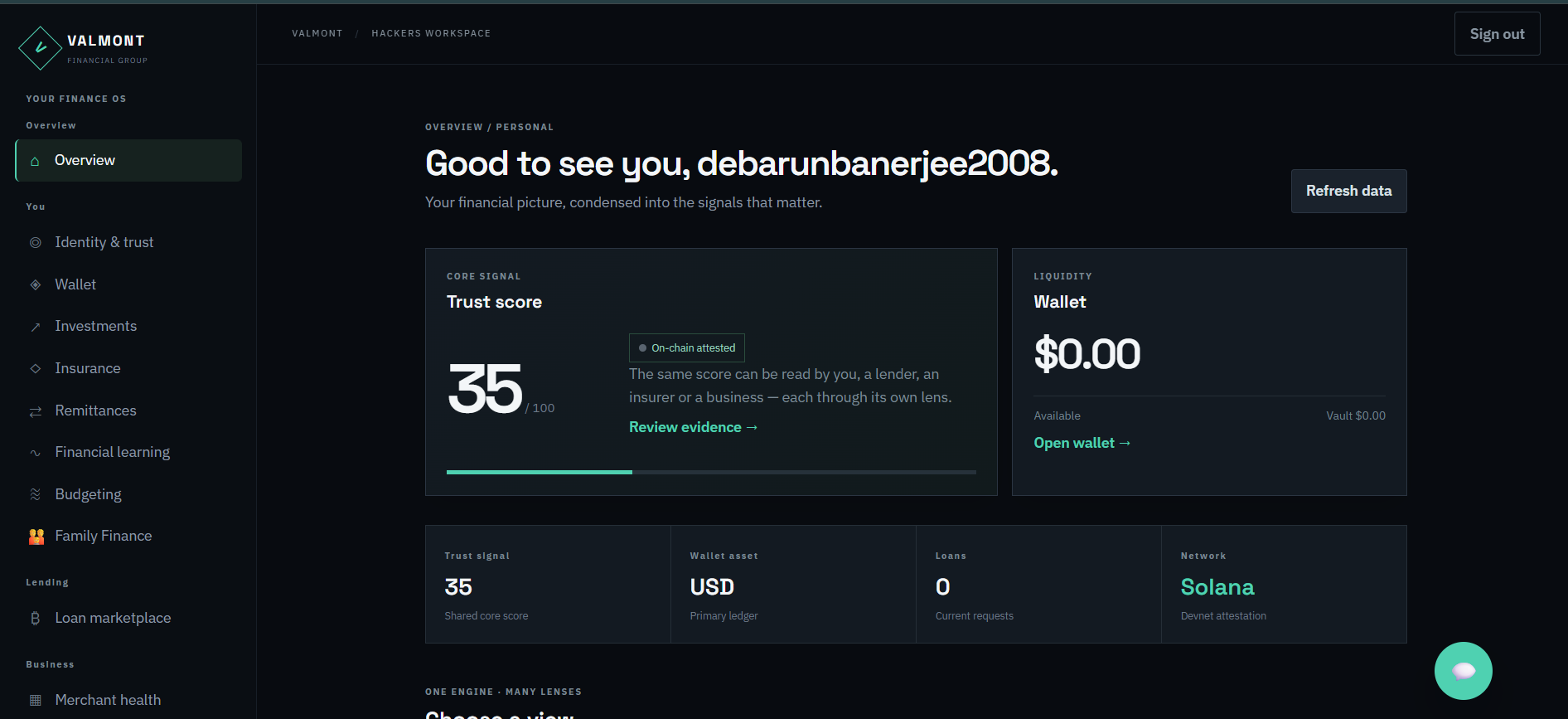
- Score goes on-chain — trust score is minted/updated as a Solana-based credential the user owns and can carry anywhere
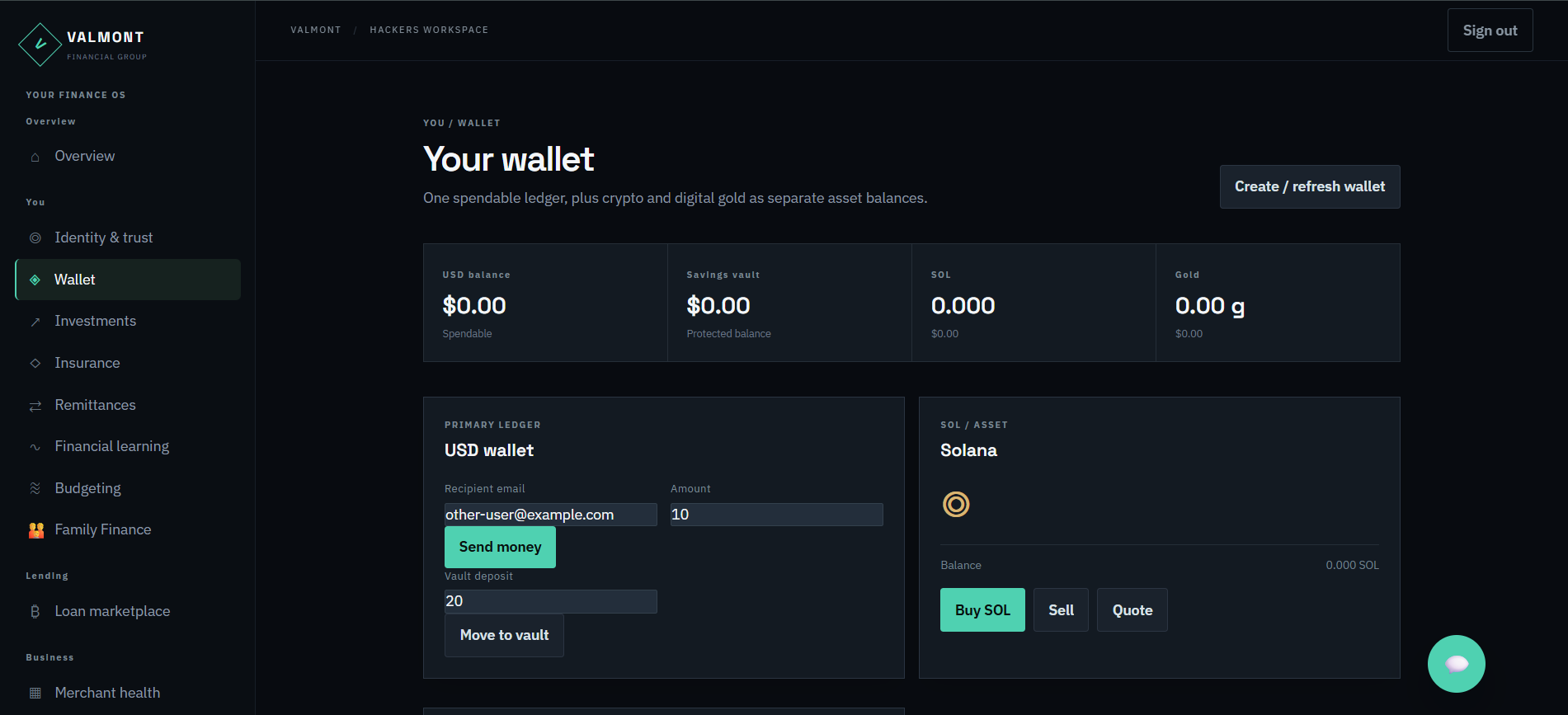
- Use the wallet — hold balance, send/receive, view transaction history, park idle funds in a savings vault
- Borrow — request a loan; rate and eligibility are driven by the trust score; matched to a lender through the marketplace
- Learn, then invest — work through the paced learning plan (regional-language voice tutorials, including crypto literacy); when ready, complete a risk-profile questionnaire and receive AI-generated (Gemini) allocation advice explained by voice; browse stocks, crypto, mutual funds/SIPs, digital gold, and fixed-income views, with live AI guidance available throughout any of them
- Grow savings — allocate idle wallet balance to a money-market vault for yield instead of sitting idle
- Protect & optimize — get insurance recommendations, tax tips, and debt-repayment guidance from the same advisory engine; receive proactive budgeting nudges
- Ongoing — voice check-ins, fraud alerts, spoken loan/portfolio updates, continued learning-plan progress
Journey B: Lender (bank/merchant)
- Sign up under the lender role (Auth0)
- Look up an individual or portfolio: see expected-loss/default-probability (the same engine as the individual's trust score) plus the evidence trail behind it
- View aggregated portfolio risk analytics (Snowflake) — cohort default trends, exposure by segment
- Review and fund loan requests from the marketplace, informed by the risk score
- Get real-time fraud flags (Tiger Data) on active, funded loans
Journey C: Enterprise/Corporation
- Sign up under the enterprise role (Auth0)
- View a treasury/cash-management dashboard (Tiger Data real-time + Snowflake aggregation)
- Run bulk payroll or gig-worker disbursement — pay workers directly into their platform wallets, which simultaneously feeds their individual trust scores (this is the standout mechanic: not a new feature, it's Journey A's onboarding viewed from the employer's side)
- Review supplier trust scores and offer supply-chain financing/invoice factoring
- Access embedded-finance APIs to white-label the wallet/lending stack into their own product
Journey D: Migrant Worker / Remittance Sender
- Onboard by voice in home language (same mechanic as Journey A step 1)
- Build a trust score as normal — a stronger score unlocks better remittance rates, same engine as lending
- Send a cross-border transfer — wallet-to-wallet, voice-guided in the sender's language, fee/rate tiered by trust score
- The recipient, if new to the platform, onboards on receipt and starts building their own trust score — a natural network effect worth naming in the pitch
3. Feature List by Module
Module 1 — Identity & Portable Trust Score (the core engine — everything else reads from this)
- Auth0 login, MFA, role-based access (individual / lender / admin)
- Solana on-chain trust-score attestation — portable, user-owned
- Gemini OCR of income documents/ledgers → income-verification signal
- Tiger Data real-time transaction monitoring → fraud-clean behavioral signal
- These signals combine into one risk/trust score — reused by every module below, never recomputed separately
Module 2 — Wallet
- Balance view (Solana devnet-backed for the demo)
- Send / receive
- Transaction history
- Round-up savings vault
Module 3 — Loan Marketplace (borrowing & lending)
- Individual requests a loan; amount/rate driven by the trust score
- Lender reviews and funds via the lender dashboard
- Repayment behavior feeds back into the trust score — closes the loop
Module 4 — AI Investment Advisory & Stocks
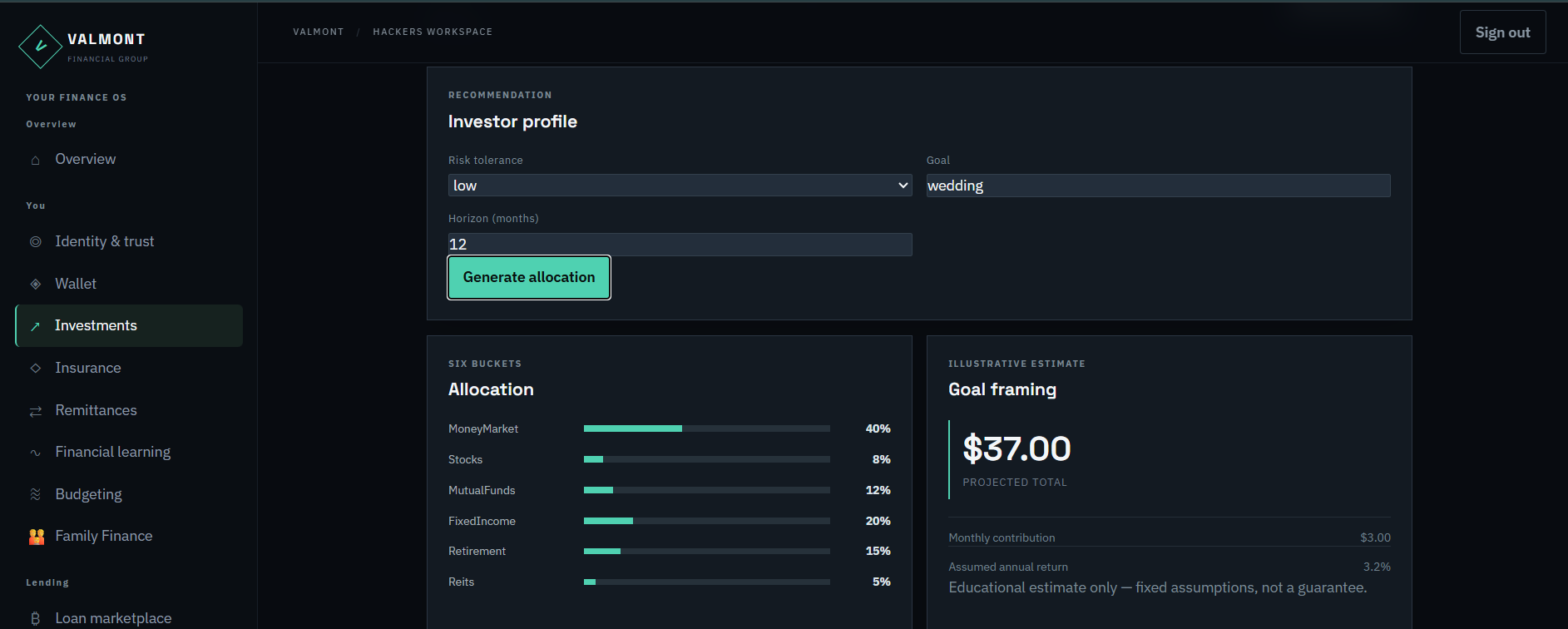
- Risk-profile questionnaire
- Gemini-generated personalized allocation advice, explained via ElevenLabs voice
- Stocks view (simulated/paper — no real market data integration in the hackathon build)
- Advisory-only, explicitly. No real trade execution. One line in the pitch should acknowledge a production version would need investment-advisory licensing — this reads as business maturity, not a gap.
Module 5 — Money Market
- Idle wallet balance can be allocated to a money-market vault for yield
- Narrative tie-in: vault deposits conceptually fund Module 3's loan pool — this is what makes the platform "universal" rather than a pile of separate features. Mention this connection in the pitch even if the mechanics are simplified in the build.
Module 6 — Loan-Loss / Risk-as-a-Service (B2B)
- The same trust-score engine, exposed as default-probability/expected-loss output
- Lender dashboard + a simple API endpoint
- Portfolio-level analytics via Snowflake
Module 7 — Fraud Detection (cross-cutting)
- Tiger Data real-time anomaly detection across wallet, loan, and investment activity
- Feeds the trust score down; triggers voice alerts (ElevenLabs) to the affected user
Module 8 — Voice & Agentic Layer (cross-cutting)
- ElevenLabs voice interface across onboarding, advisory, alerts, loan updates
- Gemini as the reasoning/orchestration layer tying modules together — risk assessment, advice generation, fraud triage all route through it
Module 9 — Investment Education & Live AI Guidance
- Regional-language tutorials on money-market and stock-market basics — narrated by ElevenLabs (multi-language voice), scripted/generated by Gemini, so a first-time investor in any supported language gets the same quality explanation
- Live AI guidance while investing — an embedded copilot in the investment flow (Module 4) that a user can ask questions of in the moment ("what does this mean," "is this a good time to move money"), answered via Gemini reasoning + ElevenLabs voice, without leaving the screen they're on
- "Video support" for investment tips — interpreted as short, voice-narrated walkthroughs synced to on-screen visuals (slides/diagrams/highlighted UI), not filmed/edited video content. This is the feasible version of "video" inside a 36-hour build; see MVP notes below.
- This module reuses Module 8's voice/agentic layer — it is a view into the same agent, not a separate assistant
Module 10 — Personalized Learning Plans (financial literacy academy)
- During onboarding, the user selects a persona/time budget: e.g. small merchant (~1 hr/day), student (~4-5 hrs), or a custom pace
- Gemini generates a step-by-step learning plan sized to that time budget — same underlying curriculum, different pacing and session length
- Lessons delivered voice-first (ElevenLabs), in regional languages, reusing Module 9's tutorial content rather than building a second content pipeline
- Tiger Data tracks engagement (lessons completed, time spent) to adapt pacing in real time
- Snowflake aggregates learning-outcome data — worth noting as a design idea for the pitch: literacy/course completion could feed back into Module 1's trust score as a positive signal (a financially-literate, engaged user is lower-risk) — mention this link in the pitch even if not wired end-to-end in the build
- This module is effectively the EdTech "vernacular voice tutor" concept (discussed earlier in planning) folded directly into the finance app, rather than built as a separate product
Module 11 — Crypto Wallet & Guided Crypto Investing
- This is not a bolt-on — Module 2's wallet was already Solana-based for the trust-score credential, so multi-asset crypto support is a natural extension of infrastructure that already exists, not a new integration
- Crypto wallet: hold SOL and additional SPL tokens, view balances, send/receive, transaction history — same wallet UI as Module 2, extended to multiple asset types rather than a separate "crypto app" bolted alongside
- Guided crypto investing: a crypto view inside Module 4's advisory dashboard — risk-profile-aware allocation suggestions that explicitly account for crypto's higher volatility (the advisory copy and disclaimers must say this out loud, not just imply it)
- Every education/guidance feature from Modules 9–10 applies to crypto too, not as a separate track:
- Regional-language tutorials cover crypto basics (what is a wallet, a seed phrase, a gas fee, volatility) using the same tutorial pipeline
- Live in-flow AI guidance answers crypto-specific questions on the same Q&A copilot used for stocks/money-market
- The persona-paced learning plan includes a crypto-literacy track, paced the same way as the rest of the curriculum
- Crypto-specific fraud/safety layer: Tiger Data extends its anomaly detection to crypto transaction patterns — this maps to a real, well-known problem (phishing, wallet-draining contracts, rug pulls) rather than a generic "fraud detection" claim. A safe crypto transaction history is a positive signal into the trust score, same pattern as Module 10's literacy tie-in.
- Advisory-only, same as Module 4. No real token swaps, no real exchange integration, no real trade execution in the hackathon build.
Why Module 11 strengthens rather than dilutes the pitch: it demonstrates the platform's core thesis — one identity, one wallet, one AI layer, one education system — extending cleanly to a new asset class without rebuilding anything. That reusability is the innovation story; say this explicitly when presenting it, rather than presenting crypto as a separate feature bullet.
Module 12 — Expanded Investment Universe
- Mutual funds / SIPs — recurring auto-invest, a bigger on-ramp for first-time investors than one-off stock picks
- Fixed income — bonds, fixed deposits, treasury bills — the risk-averse option the advisory questionnaire can route conservative users toward
- Digital gold / commodities — small-ticket entry, culturally trusted store of value in many of the same underserved markets this platform targets
- Retirement / pension planning — long-horizon, goal-based advisory flow
- Real estate / fractional REITs — included for completeness; lowest priority of this module's sub-features
- Goal-based investing framing — not a new asset class but a UI layer tying the wallet, advisory engine, and money-market vault to a named goal ("saving for a wedding/education/home") instead of a bare product list
- Every sub-feature reuses Module 4's advisory engine and Module 9's education pipeline — new asset types feed the same scoring/advice logic and the same tutorial system; this module does not introduce a new engine
Module 13 — Insurance (a third lens on the risk engine)
- Life, health, and general insurance recommendations from the same risk-profiling flow as Module 4
- The trust-score engine now serves a third audience: individual (trust score) → bank (loan-loss, Module 6) → insurer (premium-risk pricing). Same underlying signal, third presentation — keep following the "one engine, many lenses" pattern rather than building a separate underwriting model
- Voice-guided plain-language policy explanation (ElevenLabs) — insurance jargon is as big a literacy barrier as credit jargon, and the accessibility argument applies equally here
Module 14 — Expanded AI Guidance Suite
- Tax planning/optimization tips — Gemini-generated, with an explicit jurisdiction/"consult a professional" caveat in the copy
- Debt consolidation/repayment optimization — closes the loop for anyone with a loan through Module 3
- Proactive budgeting copilot — spending-pattern alerts, subscription-creep detection, overspend nudges; lightweight since it reuses Tiger Data's existing transaction stream rather than needing new data
- All delivered through Module 8's existing voice/agentic layer — these are new skills on the one agent, not new assistants
Module 15 — Cross-Border Remittances
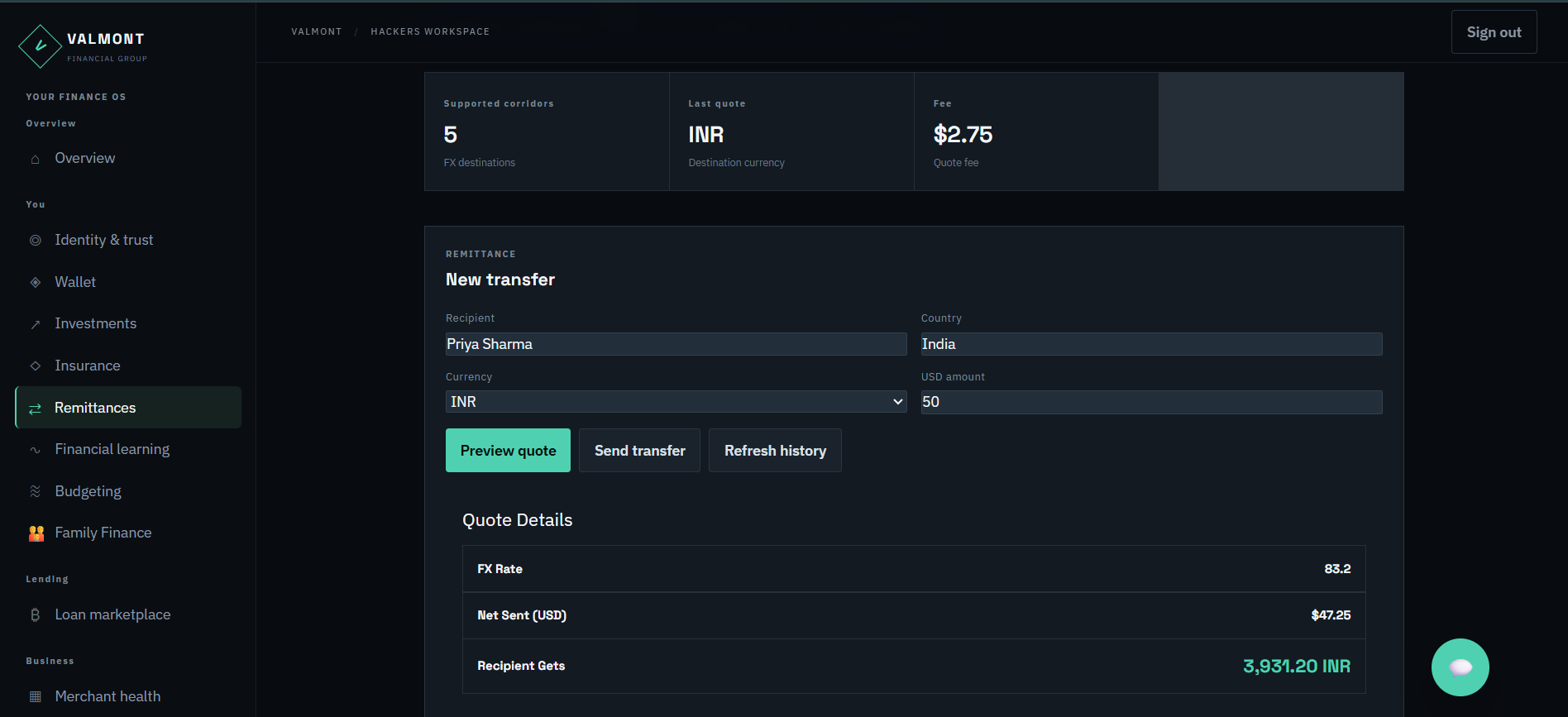
- Wallet-to-wallet cross-border transfer; fee/rate tier determined by the sender's trust score, same mechanic as loan pricing
- Voice-guided sending flow in the sender's regional language (reuses Module 9's tutorial/voice pipeline directly)
- A first-time recipient onboards on receipt and starts building their own trust score — a genuine network effect, and a direct match to the FinTech track's explicit "cross-border remittances and inclusive banking" wording
Module 16 — Enterprise/Corporate Suite (B2B, beyond lenders)
- Treasury/cash-management dashboard — reuses Tiger Data's real-time pipeline and Snowflake's aggregation, same infrastructure as Module 6's lender dashboard
- Bulk payroll & gig-worker disbursement — a corporation pays workers directly into their platform wallets, simultaneously feeding those workers' trust scores. This is the standout feature of this module: it's not a new concept, it's the platform's entire gig-worker thesis viewed from the employer's side
- Supply-chain financing/invoice factoring — using supplier trust scores, a fourth lens on the Module 1 engine
- Embedded-finance APIs — lets a corporate client white-label the wallet/lending stack into their own product; a genuine B2B2C revenue line worth naming explicitly in the Business Aspect pitch
Module 17 — Merchant Expansion
- Payment acceptance/POS — merchant-side counterpart to Module 2's wallet
- Inventory-linked working capital loans — extends Module 3's loan marketplace with a merchant-specific loan type
- Merchant "business health score" — a fifth lens on the same Module 1 risk engine, this time framed for the merchant's own operational health rather than a lender's underwriting decision
Module 18 — Student Persona Expansion
- Education financing/student loans — extends Module 3 for this specific persona
- "Starter identity" — an onboarding path for someone with zero financial history: the trust score is seeded from Module 10's learning-plan completion instead of income/transaction data. This is the literal mechanism behind the "literacy could feed the trust score" idea flagged in Module 10 — here it becomes the entire onboarding path for one named persona, not just a pitch aside