GOD'S EYE
Of course, bro! Since GOD'S EYE is your Vortex V team's search-and-rescue project, here are two professional, hackathon-ready answers tailored to your actual prototype, including the drone, AI detection, GPS positioning, and Mixed Reality HUD.
You can copy-paste these directly into Devfolio.
1. The problem it solves
Writing
Search-and-rescue operations in disaster-struck, remote, and hazardous environments are often hindered by limited visibility, inaccessible terrain, and the time required to locate survivors. Rescuers may have to manually search large areas while facing potential risks from unstable structures and dangerous surroundings. Traditional drone surveillance also requires operators to continuously monitor video feeds and interpret information separately, delaying the identification and localization of survivors.
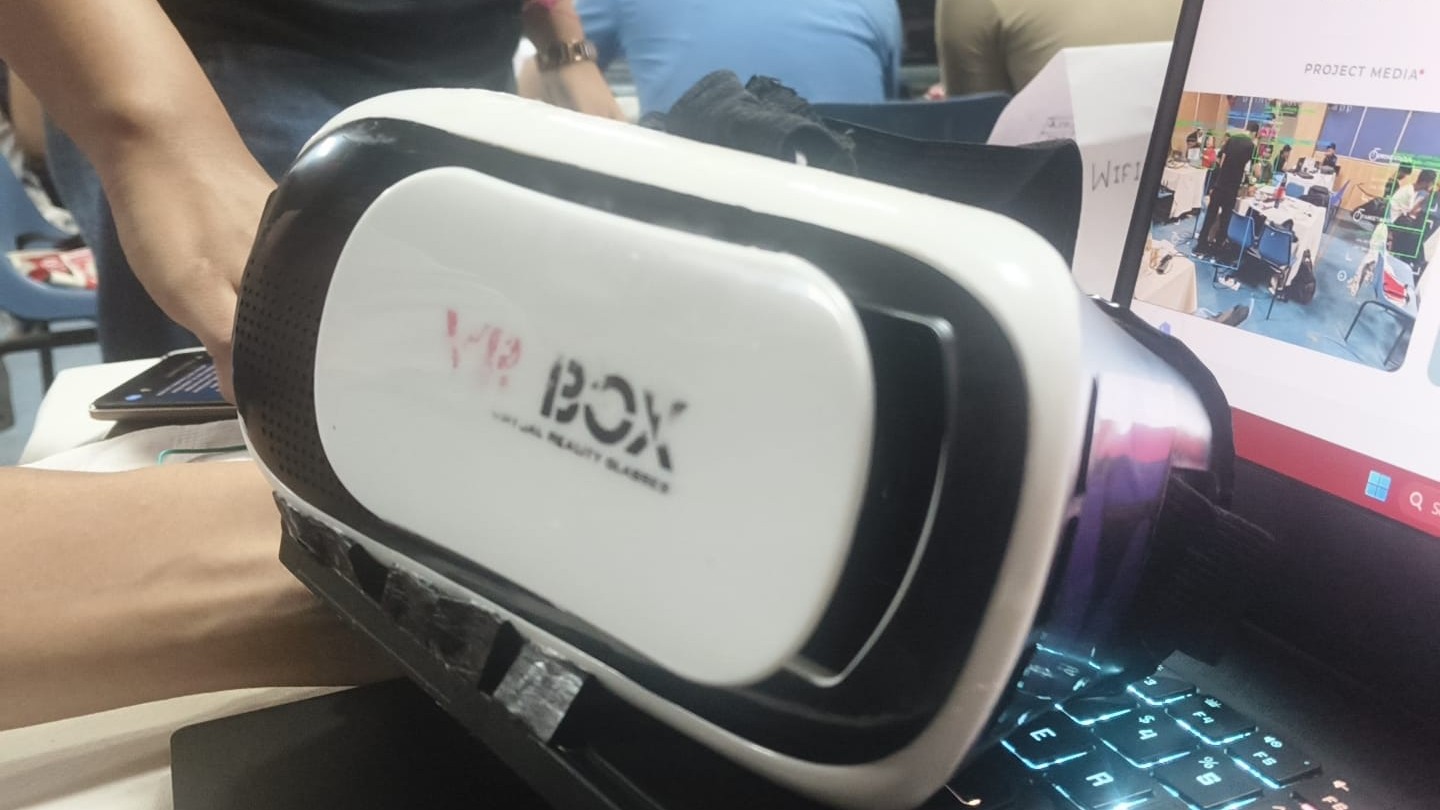
GOD'S EYE addresses these challenges through an AI-powered drone surveillance and Mixed Reality (MR) assistance system. It processes live drone footage using computer vision to identify potential human targets and combines detection results with GPS-based positioning to provide location and directional information. These insights are presented through an immersive MR heads-up display, allowing rescuers to access critical information without constantly shifting their attention to a separate screen.
By integrating aerial surveillance, AI-assisted detection, GPS tracking, and real-time MR visualization, GOD'S EYE aims to improve search efficiency, situational awareness, and rescuer safety during emergency response operations.
2. Challenges we ran into
Writing
One of the major challenges was integrating multiple hardware and software components into a single real-time system under a limited budget. Establishing a stable live video stream from the drone or smartphone to the laptop while running AI-based human detection required extensive debugging and performance optimization.
Another challenge was achieving reliable human detection in complex environments, particularly when targets were partially occluded, appeared at different distances, or were surrounded by clutter. Integrating GPS data from multiple devices to calculate the target's distance, bearing, and relative direction also required careful synchronization and coordinate handling.
Developing an immersive Mixed Reality HUD presented additional difficulties, including anchoring directional markers, displaying live telemetry, and implementing reliable hand-gesture controls using MediaPipe. We also encountered connectivity issues between the soldier and test-person devices.
We addressed these challenges through iterative prototyping, testing individual modules, optimizing the computer vision pipeline, debugging communication protocols, and refining the HUD based on real-world testing. Working within hardware and budget constraints pushed us to develop a modular, cost-conscious prototype that combines AI, GPS, and MR into a unified search-and-rescue assistance system.
My suggestion: Use both exactly as written. They explain the actual problem and the technical hurdles your team faced, without claiming that the prototype already achieves fully autonomous rescue or reliable through-wall detection.
video link : https://youtu.be/CNMrlsbyaYI?si=BrnHGbn7VyNUu2GT